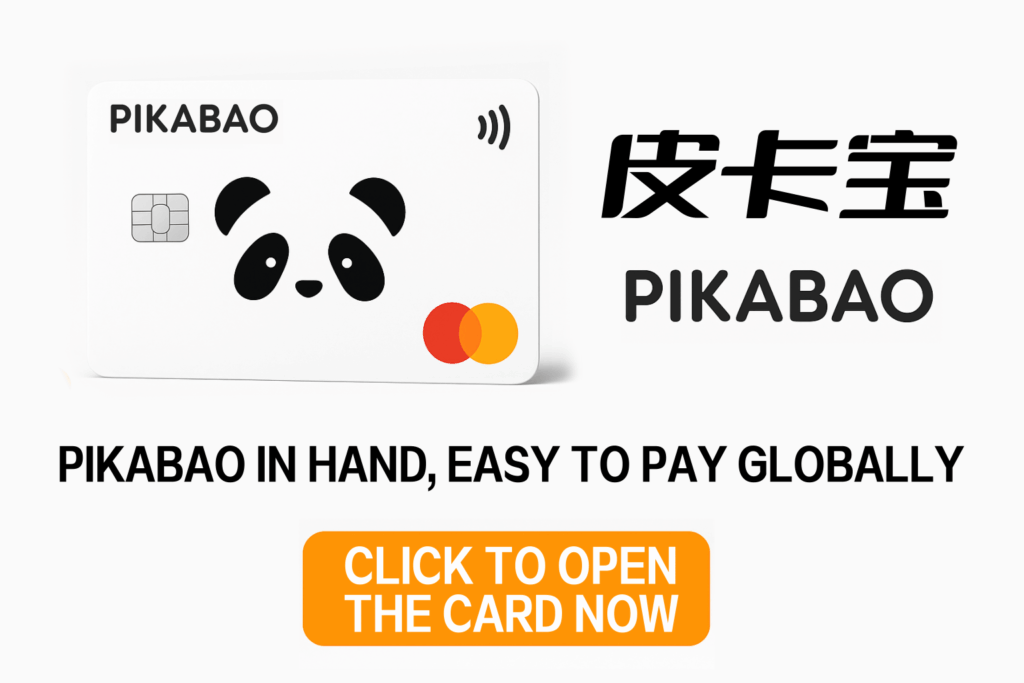
From Payment Headache to Operational Advantage
2025 just ended.
And if you’re selling cross-border, you already know the game has changed.
TikTok Shop went full-throttle on managed services.
Temu and SHEIN are battling it out overseas.
ChatGPT and AI tools are now mandatory for operations.
But here’s what nobody talks about enough: the real competition isn’t about product selection or logistics anymore.
It’s about cash flow management and payment efficiency.
For new sellers, the first roadblock isn’t traffic.
It’s payment itself.
How do you fund your Facebook Ads account?
How do you pay for dozens of SaaS subscriptions every month?
How do you connect your Shopify backend without a US or Hong Kong bank account?
There’s only one answer: Virtual Credit Cards (VCC).
What used to be a niche tool for international shopping has evolved into critical infrastructure for cross-border commerce.
Need a reliable VCC for your cross-border business? Start with Pikabao Virtual Credit Card: t.me/pikabaobot?start=5e228275-4
Part 1: What Actually Is a VCC? More Than Just a “Cardless Credit Card”
By definition, a VCC is a digital payment tool.
It has its own card number, expiration date, and CVV security code.
But it exists purely in digital form. No plastic card.
Here’s the critical distinction most people miss:
99% of VCCs available to cross-border sellers are actually “virtual prepaid cards.”
Unlike traditional credit cards issued by Western banks that offer credit lines, the VCC model popular in Asia is “load first, spend later.”
No credit leverage. No borrowing.
It’s essentially an electronic wallet connected to the Visa or Mastercard payment network.
You can only spend what you’ve loaded onto the card.
Why does this model dominate?
Because most sellers outside the US and EU lack convenient access to international payment methods.
VCCs fill that gap perfectly.
Part 2: Why Cross-Border Sellers Can’t Operate Without VCC—Four Critical Scenarios
In 2026, cross-border operations have become fragmented and hyper-specialized.
VCCs have evolved beyond simple payment tools into precision operational instruments.
Scenario 1: Ad Spend Management—Your Budget’s Best Friend
Whether it’s Meta (Facebook), Google Ads, or TikTok Ads, a failed payment that pauses your account is every seller’s nightmare.
Multi-card management reduces risk:
Experienced sellers generate separate VCCs for each ad account—sometimes even for individual campaigns.
Why?
If one card has issues (insufficient balance, flagged by platform fraud detection), it won’t kill all your advertising activity.
Precise budget control:
Set spending limits per transaction or per month on each VCC.
Prevents budget blowouts from accidental clicks or malicious activity.
Pikabao Solution: Create unlimited virtual cards with individual spending controls. Isolate risk. Control costs. Scale intelligently.
Scenario 2: Store Subscriptions and SaaS Overload
A mature cross-border operation typically juggles:
- Multiple Amazon stores
- Several Shopify sites
- Dozens of ERPs, product research tools, SEO analyzers
Avoid the “bundling” trap:
Many sellers used to bind one dual-currency credit card to multiple platforms.
When that card got lost, reissued, or compromised, every single service failed to charge.
Stores went offline. Tools stopped working.
With VCC, you implement “one card per store” or “one card per tool.”
Prevent “auto-renewal” nightmares:
Many tools auto-renew after free trials.
Use VCC’s “single-use” function or set extremely low spending limits to block unwanted charges automatically.
Pikabao Solution: Generate dedicated cards for each subscription. Freeze cards to pause subscriptions without canceling. Resume anytime.
Scenario 3: Platform Ad Credits (Shopee, Lazada, Regional Marketplaces)
Southeast Asian sellers on Shopee face constant friction with traditional top-up methods.
Local bank card requirements. Expensive currency conversion. Endless delays.
Direct currency top-up:
Modern compliant VCC platforms support direct top-up in your local currency or via crypto/third-party payments.
Then settle in local currency (Thai Baht, Indonesian Rupiah, etc.).
This drastically simplifies the process and minimizes currency loss.
Instant availability:
Virtual cards are generated and ready to bind immediately.
No waiting for cross-border transfers or lengthy approval processes.
Your ads keep running without interruption.
Pikabao Solution: Supports USDT crypto top-up for borderless, fast, and private funding. Works globally.
Scenario 4: Testing and Account Isolation Tactics
Within legal boundaries, VCC provides operational flexibility that physical cards can’t match.
Batch operations:
For high-volume product testers or dropshippers, VCC supports bulk card generation to meet multi-account payment needs.
Privacy protection:
When paying on unfamiliar websites, VCC hides your primary card information.
If the site gets breached, your main card stays safe.
Pikabao Solution: Instant multi-card issuance through simple Telegram bot interface. No complex apps. No friction.
Open your first card here: t.me/pikabaobot?start=5e228275-4
Part 3: Compliance and Risk—The Red Lines Sellers Must Understand in 2026
Since 2025, global financial regulation has tightened significantly.
The VCC industry’s wild-west days are over.
If you’re not careful choosing and using VCC, you risk frozen funds or legal consequences.
Red Line 1: Licensing Is Your Shield
The market includes licensed payment institutions (like LianLian International with domestic and overseas licenses).
It also has countless fly-by-night platforms built on outsourced tech.
How to tell the difference:
Prioritize platforms holding Hong Kong MSO (Money Service Operator) licenses, US MSB licenses, or domestic payment business permits.
If a platform lets you open cards with just a phone number—no KYC (identity verification) required—it’s probably operating in a regulatory gray zone.
Or worse.
Pikabao Standard: Compliant operations with proper identity verification. Your funds are protected by legitimate regulatory frameworks.
Red Line 2: Beware “Fund Pool” Risks
The prepaid VCC model means user funds accumulate in platform accounts.
Legal classification:
If a VCC platform directly controls the fund pool and misappropriates it, they could cross into illegal fundraising territory.
Best practice:
Choose platforms where funds are held in custody by licensed banks or third-party institutions.
Adopt “load and spend immediately” habits.
Don’t leave large balances sitting idle for long periods.
Pikabao Approach: Transparent fund handling with clear terms. Load only what you need when you need it.
Red Line 3: Payment Success Rates and Card BINs
“Why does my VCC keep getting declined?”
Sellers ask this constantly.
AVS verification:
Some US websites require strict Address Verification System (AVS) checks.
Many virtual cards don’t support this.
For US-targeted markets, choosing card BINs that support AVS is critical.
3DS verification:
In 2026, 3DS 2.0 authentication is mainstream.
Ensure your VCC supports 3DS verification to improve payment success rates and reduce chargeback disputes.
Pikabao Advantage: Real US BIN numbers with high compatibility across international platforms. Supports 3DS authentication for maximum acceptance.
Part 4: Operational Guide—Build Your VCC Payment System
In 2026, mature cross-border sellers don’t scramble for cards at the last minute.
They build robust payment infrastructures.
Step 1: Choosing Your Provider
For individual/small sellers:
Prioritize platforms with public company backing, local currency deposits, and user-friendly interfaces.
These platforms offer high security, transparent fees (average ~0.3%), and cover most mainstream scenarios.
For enterprises/crypto users:
If you’re in Web3 or use USDT and other cryptocurrencies, configure platforms supporting crypto top-ups.
They often offer better exchange rates and faster settlement.
Pikabao Fits Both:
- Telegram-based interface (dead simple)
- USDT top-up support (crypto-friendly)
- Transparent fee structure
- Instant card generation
- Real US BIN compatibility
Step 2: Card Opening and Binding Strategy
Naming convention:
Set clear aliases for each card, like “FB-Main-US-1000” (Facebook main account US, $1000 monthly limit).
Fund planning:
For variable costs like ad spend, reserve 10-20% buffer funds to prevent payment failures from currency fluctuations or spending spikes.
Step 3: Ongoing Maintenance
Regular reconciliation:
Use your VCC platform’s transaction records to cross-check against platform billing statements.
Immediate cancellation:
For deprecated card BINs or suspected compromised cards, freeze or cancel them in the backend immediately and generate new ones.
Pikabao Makes This Easy: Real-time transaction tracking. One-tap freeze/unfreeze. Instant card replacement.
Part 5: Real Talk—Common VCC Pain Points and How Pikabao Solves Them
Pain Point 1: “My card keeps getting declined on major platforms”
Why it happens:
Wrong card BIN region. No 3DS support. Blacklisted BIN database.
Pikabao solution:
Real US-issued BIN numbers recognized by OpenAI, Google, Apple, Meta, Amazon, and hundreds of others.
High first-time approval rates.
Pain Point 2: “I can’t track which card paid for what subscription”
Why it happens:
Using one card for everything creates a chaotic mess.
Pikabao solution:
Create separate cards per service. Name them clearly. Review them at a glance in your dashboard.
Pain Point 3: “I’m paying hidden fees I didn’t know about”
Why it happens:
Shady platforms bury charges in fine print.
Pikabao solution:
Transparent fee structure. No surprise deductions. You know exactly what you’re paying upfront.
Pain Point 4: “Top-up takes forever and limits are too low”
Why it happens:
Traditional bank transfers. Regulatory bottlenecks. Arbitrary platform caps.
Pikabao solution:
USDT crypto top-up arrives in minutes. Higher limits for verified users. Seamless and fast.
Pain Point 5: “Customer support is nonexistent when I need help”
Why it happens:
Many VCC platforms are automated with no real human support.
Pikabao solution:
Responsive support team. Fast response times. Issues resolved, not ignored.
Try Pikabao risk-free: t.me/pikabaobot?start=5e228275-4
Part 6: Platform Compatibility—Where Pikabao VCC Works
Let’s get specific.
Here’s where Pikabao virtual cards are proven to work:
AI and Productivity Tools
- ChatGPT Plus and Team
- OpenAI API credits
- Claude Pro
- Midjourney subscriptions
- Notion, Grammarly, Canva Pro
Advertising Platforms
- Facebook Ads / Meta Business Suite
- Google Ads
- TikTok Ads
- Twitter (X) Ads
- LinkedIn Ads
Ecommerce Platforms
- Shopify (all plans)
- Amazon Seller Central
- eBay
- Etsy
- WooCommerce
App Stores and Digital Content
- Google Play (US region)
- Apple App Store (US region)
- Steam
- PlayStation Network
- Xbox Live
Subscription Services
- Netflix, Spotify, YouTube Premium
- Adobe Creative Cloud
- Microsoft 365
- Dropbox, iCloud storage
Southeast Asian Marketplaces
- Shopee Ads top-up
- Lazada advertising credits
- Regional platform payments
If it accepts Visa/Mastercard online, Pikabao works.
Part 7: The Bigger Picture—Why VCC Matters Beyond Payments
Payment isn’t just a transaction.
It’s operational infrastructure.
In cross-border commerce, your VCC setup determines:
How fast you can scale:
More cards = more accounts, more tests, more simultaneous campaigns.
How safe your business is:
Isolated cards = isolated risk. One compromised card doesn’t burn down your entire operation.
How efficiently you manage cash flow:
Precise spending controls = no budget blowouts, no surprise charges, no wasted ad spend.
How compliant you stay:
Licensed platforms with proper KYC = regulatory protection, fewer account freezes.
In 2026, the question isn’t “Should I use a VCC?”
It’s “Which VCC platform can scale with my business?”
The answer for most sellers: Pikabao.
Part 8: Common Myths About VCC—Let’s Kill Them
Myth 1: “VCCs are sketchy and unregulated”
Reality:
Shady platforms exist, yes.
But licensed, compliant VCC providers like Pikabao operate within legal frameworks and offer legitimate services.
Myth 2: “VCCs are only for small transactions”
Reality:
Pikabao supports high-value transactions for verified users.
Businesses use VCCs to manage thousands of dollars in monthly ad spend.
Myth 3: “I’ll get my accounts banned for using a VCC”
Reality:
Platforms ban accounts for suspicious behavior, not for using VCC.
If your card has a clean BIN, proper verification, and normal spending patterns, you’re fine.
Pikabao’s US BINs are recognized and accepted widely.
Myth 4: “Physical cards are safer than virtual cards”
Reality:
Physical cards can be lost, stolen, skimmed, and cloned.
Virtual cards can be frozen instantly, regenerated, and isolated per use case.
VCCs are objectively safer when used correctly.
Final Thoughts: Payment Is Operations
In the complex ecosystem of cross-border ecommerce, VCC is no longer a simple “wallet” or “card.”
It’s the digital bridge connecting sellers to global markets.
For 2026 sellers, the criteria for choosing VCC has shifted:
It’s not about who has the lowest card fees anymore.
It’s about who’s more compliant, more stable, has higher BIN success rates, and covers more scenarios.
Master VCC correctly, and you unlock:
- Global payment capability
- Precision operational control
- Cost management
- Risk mitigation
In this era of borderless payments, how far your business can grow sometimes depends on where your virtual card can pay.
Start building your cross-border payment infrastructure today with Pikabao: t.me/pikabaobot?start=5e228275-4